What Happens Behind Your Siding (That Most Homeowners Never See)
From the street, your home can look perfect—clean siding, straight lines, fresh color.
But what really matters… is what’s going on behind that siding.
Because that’s where problems start—and where the most expensive damage happens.
Let’s break it down so you know exactly what’s back there, and what can go wrong.
What’s Actually Behind Your Siding?
Your siding is just the outer layer. Behind it is a full system designed to protect your home.
From outside to inside, you’ve typically got:
- Siding (vinyl, LP, steel, etc.)
- Trim and flashing
- House wrap or moisture barrier
- Sheathing (OSB or plywood)
- Framing (studs)
- Insulation
Every layer has a job.
And if one part fails, it affects everything behind it.
What Happens When Everything Is Done Right
When your exterior is installed properly:
- Water is directed away from the home
- Air infiltration is minimized
- Walls stay dry
- Insulation performs the way it should
You never think about it—which is exactly how it’s supposed to be.
What Happens When It’s Not Done Right
Here’s where things get real.
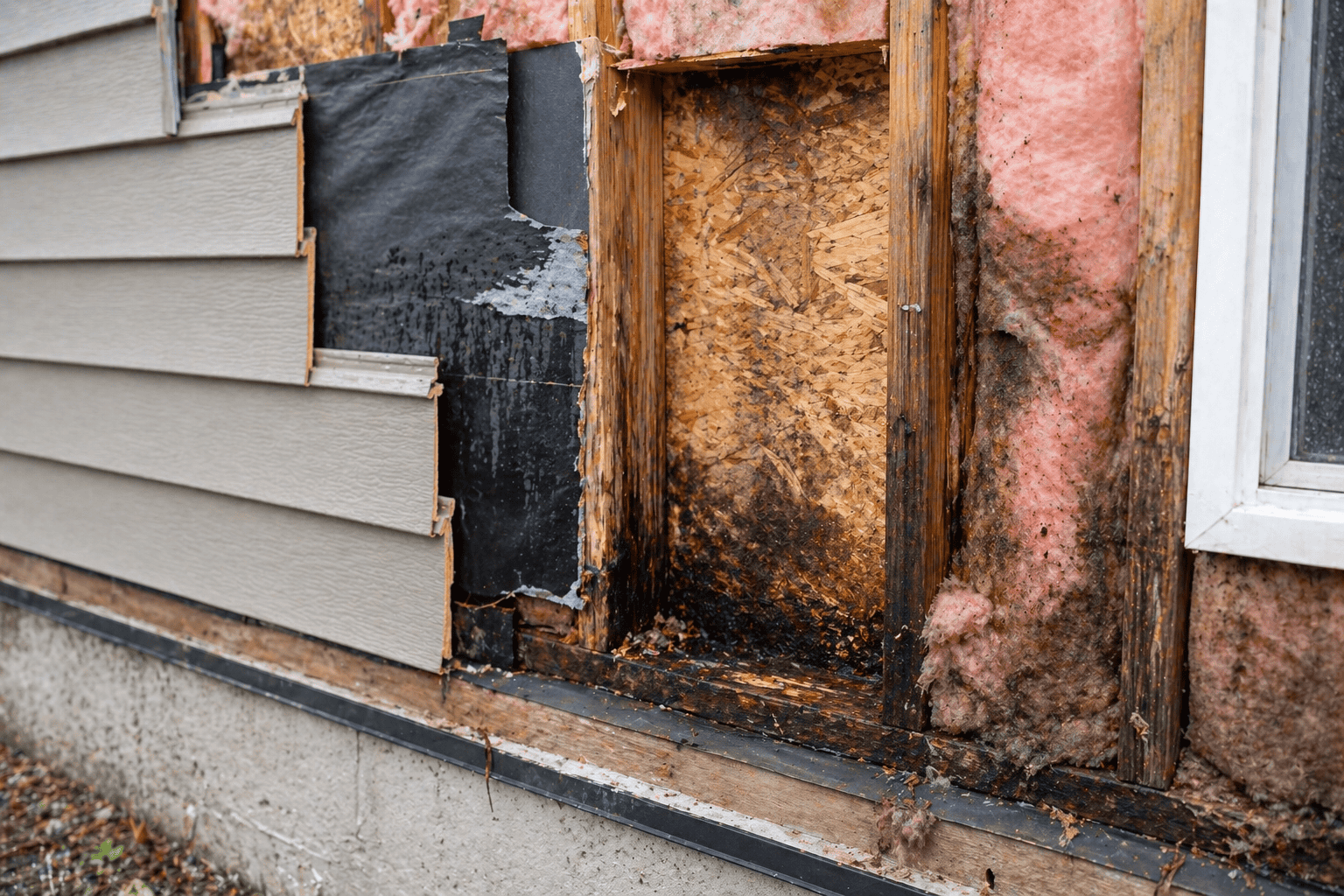
1. Moisture Gets In
Water doesn’t need a big hole—just a small gap.
If flashing or house wrap is done wrong:
- Water slips behind the siding
- It gets trapped inside the wall
- It starts soaking everything
2. Rot Starts (And Spreads)
Once moisture is in:
- Sheathing begins to rot
- Framing weakens
- Structural integrity is compromised
This doesn’t happen overnight—but it doesn’t take long either.
3. Mold Develops
Dark + damp = mold.
And behind your siding is the perfect environment.
Mold can:
- Spread quickly
- Affect indoor air quality
- Create health concerns
And you usually won’t know it’s there until it’s advanced.
4. Insulation Fails
Wet insulation doesn’t insulate.
That means:
- Heat escapes in winter
- Energy bills go up
- Your home feels uncomfortable
And now you’re paying more for less performance.
5. Damage Shows Up Too Late
By the time you see signs like:
- Bubbling siding
- Soft spots
- Stains inside your home
The problem has already been there for a while.
And at that point, you’re not just fixing siding—you’re fixing the structure.
Why This Happens So Often
Because a lot of exterior jobs are done:
- Too fast
- Too cheap
- Without proper attention to detail
Corners get cut where you can’t see them:
- Missing flashing
- Poor sealing
- Incorrect layering
And that’s exactly where the problems start.
Why Proper Installation Matters
This is where a professional install makes all the difference.
Done right, your exterior system:
✔ Sheds water properly
✔ Allows moisture to escape
✔ Protects your framing and insulation
✔ Lasts for decades
Done wrong, it becomes a hidden problem waiting to happen.
Why This Is a Big Deal in Montana
Montana weather makes everything worse:
- Snow sits against your house
- Freeze-thaw cycles push water deeper
- Cold temps slow drying
- Wind forces moisture into small gaps
If your siding system isn’t built correctly, it will fail faster here than in most places.
Signs You Might Have Hidden Issues
Keep an eye out for:
- Warped or bulging siding
- Musty smells inside
- Higher energy bills
- Soft trim or window areas
- Water stains near walls
These are warning signs—not something to ignore.
The Bottom Line
Your siding isn’t just about looks.
It’s protecting everything behind it:
- Your structure
- Your insulation
- Your home’s value
And most of that protection depends on what you can’t see.
Done Right the First Time
At MCLC Contracting, we don’t just make your home look good—we make sure it’s built to last behind the surface.
That means:
✔ Proper flashing
✔ Full moisture barrier systems
✔ Installation done to spec
Because that’s what keeps your home protected long-term.
Need Your Exterior Checked?
📞 406-565-3999
📧 mclccontracting@gmail.com
🌐 www.mclccontracting.com
Built Right. Built to Last.
🔗 Helpful Resources
- Building Science Corporation
https://buildingscience.com - U.S. Environmental Protection Agency
https://www.epa.gov/mold - International Code Council
https://www.iccsafe.org - U.S. Department of Energy
https://www.energy.gov/energysaver